
Tongue Tie (Ankyloglossia) in Newborns
What tongue tie is, how it's diagnosed, what the current Australian and international consensus says, and when surgery actually helps.
- Last reviewed
- Sources cited
- 7 sources
- Author
- Dr Jubal John, FRACP
- Category
- medical guides
This page is being reviewed
We’re double-checking this content before publishing it — it’ll be available here shortly.
In the meantime, browse the published guides or contact the rooms.
Take-home
A tongue tie is a short strip of tissue (the frenulum) under the tongue that can, in some babies, limit how far the tongue moves. The current Australian Dental Association (ADA) and American Academy of Pediatrics (AAP, 2024) consensus is the same: start with a full feeding assessment and lactation support. Surgery (frenotomy) should only be considered when there is a clearly-defined structural tie and feeding problems that don’t resolve with good non-surgical care. Most babies with “tongue tie” do not need surgery.
What is a tongue tie?
Every baby is born with a frenulum, a thin strip of tissue connecting the underside of the tongue to the floor of the mouth. In some babies, this strip is unusually short, thick, or attaches closer to the tip of the tongue. This is called ankyloglossia, or simply tongue tie. In an anterior tie the frenulum reaches near the tip, so the lifted tongue can be drawn into a tell-tale heart-shaped notch, like the photo below.
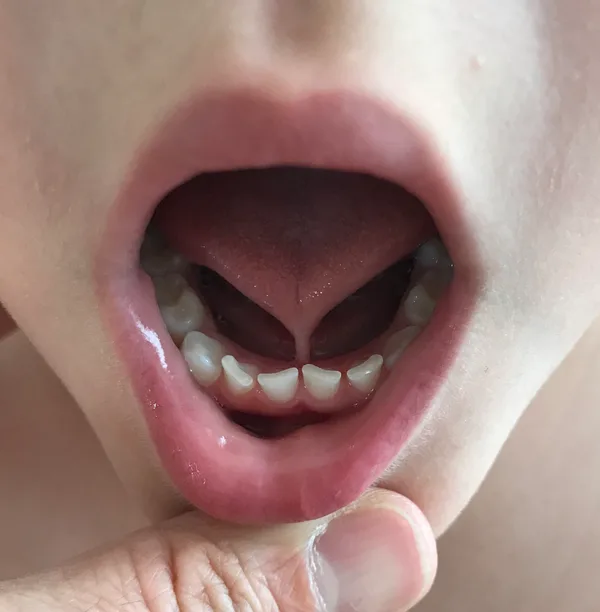
An anterior tongue tie: the frenulum reaches the tip and draws it into a heart-shaped notch when the tongue lifts. The anatomy reads the same in a newborn.
Photograph by Gzzz, via Wikimedia Commons, used under CC BY-SA 4.0 (resized and recompressed).
The word “tie” is a bit misleading, it’s not a knot. It’s just anatomy. The question isn’t “is there a frenulum?” (every baby has one) but “is this particular frenulum actually stopping the tongue from doing what it needs to do?”
Why does it matter?
In a small number of babies, a restrictive frenulum can contribute to:
- Difficult breastfeeding: shallow latch, clicking sounds, nipple pain or damage, poor weight gain
- Slipping off the bottle teat repeatedly
- Fussy, prolonged feeds that never seem to fill the baby
But, and this is the key point, most feeding problems in newborns are not caused by tongue tie. The 2024 AAP clinical report notes a nearly 10-fold rise in tongue-tie diagnoses and frenotomy rates between 1997 and 2012, and a further doubling between 2012 and 2014. The report is careful to say it’s unclear how much of that is a genuine increase versus better detection. Either way, the steep climb has driven a strong international push to slow down and assess properly before reaching for surgery.
What usually causes early feeding problems
- Latch technique, often correctable with lactation-consultant support
- Positioning, cradle, cross-cradle, laid-back, football holds matter more than people realise
- Forceful letdown / engorgement in the first week
- Mum-side pain from a blocked duct, thrush, vasospasm
- Tired-baby mechanics, sleepy feeds, slow weight gain
- Reflux, cow’s-milk-protein intolerance, prematurity
A good lactation consultant can work through all of these in a single visit. That’s the place to start.
How is tongue tie diagnosed?
There is no single test. Clinicians combine:
- A full feeding history: is there actually a functional problem, or just a visible frenulum?
- Examining the baby’s mouth: how far the tongue lifts, how far it sticks out, whether the tip looks heart-shaped when the baby cries
- Watching a feed: latch, suck-swallow coordination, audible swallows, maternal comfort
- Weight trajectory + nappy output: objective markers of whether feeding is actually working
What this means in practice
A baby with a visible frenulum but normal weight gain, comfortable feeds, and pain-free maternal breastfeeding does not have a functional tongue tie, regardless of what the anatomy looks like. “Tongue tie” is a functional diagnosis, not a photograph.
Picture-based scoring: the TABBY tool
When clinicians want a quick, reproducible appearance score, the most widely-used parent-friendly tool is the TABBY (Tongue-tie And Breastfed BabY) picture assessment, developed at the University of Bristol. Each of four questions scores 0–2; the total is out of 8.
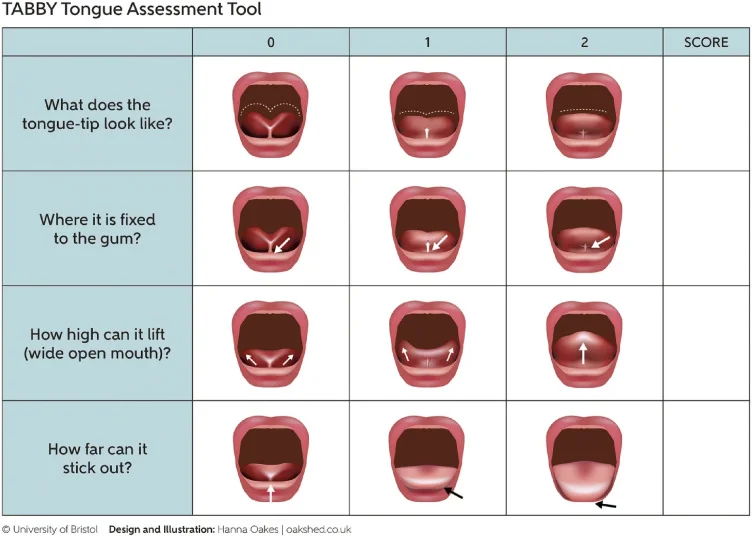
8Normal — tongue function looks unrestricted; no action needed beyond ordinary lactation support.
6-7Borderline — pair with a feeding review; most resolve with good positioning and latch support.
0-5Suggests impairment — refer for assessment (lactation consultant first, then surgical opinion if feeding problems persist).
What's used here in Melbourne
At The Royal Women’s Hospital Melbourne, the Breastfeeding Education and Support Services team (BESS) has used the more detailed Hazelbaker Assessment Tool for Lingual Frenulum Function (HATLFF) since the early 2000s. A local reliability study (Amir, James & Donath, Int Breastfeed J 2006) found substantial inter-rater agreement between trained assessors (kappa > 0.65 on the key tongue-function items). TABBY (above) is the simpler picture-based version many midwives and GPs use as a first-pass screen.
Either way, the score is one piece of the puzzle, a feeding assessment is what actually decides whether release helps.
How the HATLFF scores it
The Hazelbaker tool scores the tongue’s appearance and, above all, its function: how it lifts, extends, spreads, cups and moves during a feed. It’s a proprietary, credentialed assessment (© Alison Hazelbaker, IBCLC) carried out by trained clinicians; the Hazelbaker Lactation Institute runs the course used by most IBCLCs. The score is only one input, a feeding assessment is what actually decides whether a release would help.
“Anterior” vs “posterior” tongue tie
- Anterior tongue tie: the frenulum attaches at or very near the tip of the tongue. This is what the classic “heart-shaped tongue” describes, and it’s the type both ADA and AAP recognise as a potential structural cause of feeding problems.
- Posterior tongue tie: a submucosal restriction further back under the tongue. Both the ADA consensus statement and the 2024 AAP clinical report highlight that posterior tongue tie is poorly defined, lacks validated diagnostic criteria, and is often a label applied to feeding problems with other causes. The recommendation is the same in both documents: work through non-surgical management first.
Non-surgical management comes first
Both the ADA and the AAP are explicit on this. Before any surgical release, the baby + parent should have:
Green — usually fine
Step 1: Lactation support first

- Full feeding assessment by an IBCLC-credentialed lactation consultant
- Positioning and latch work
- Review of feeding frequency, duration, nappy output and weight
- Address maternal nipple pain, supply, letdown, engorgement
Amber — be alert
Step 2: Address other contributors

- Reflux, cow’s-milk-protein intolerance screening if symptoms suggest it
- Oral motor assessment by an SLP or IBCLC if suck is uncoordinated
- Treatment of nipple thrush or mastitis if present
- Feeding plan optimisation (paced bottle feeding, protected breastfeeds, top-ups if needed)
Red — act now
Step 3: Consider surgical release only if

- A clearly structural anterior tie is identified
- Feeding problems persist despite the above
- Surgery is done by an appropriately trained clinician in an appropriate clinical setting
What a frenotomy actually involves
If release is appropriate, the procedure itself is brief: a local anaesthetic gel (or sometimes nothing), a scissor division of the frenulum, a small amount of bleeding, and an immediate feed to comfort the baby. The 2024 AAP review found no evidence that laser frenotomy outperforms scissor division in babies under 6 months, so either approach is acceptable, scissors are simpler, less expensive, and have a longer safety record.
Post-frenotomy stretches, not recommended
Some providers recommend “active wound stretches” multiple times daily after release. The current evidence does not support this. The AAP clinical report and most paediatric centres recommend letting the wound heal normally, with feeding as the “stretch”.
What a good latch looks like (regardless of tongue tie)
Four signs of a comfortable, effective latch
- Asymmetric latch: more areola visible above the top lip than below.
- Flanged lips: both lips rolled out like a fish, not tucked in.
- Chin to breast: head tilted slightly back, chin pressed into the breast.
- Nose free: the tip of the nose is clear, not buried in breast tissue.
If these four features are hard to achieve even with help, a lactation consultant is the right next step, not the dentist.
When to seek help
Green — usually fine
Green: normal
- Feeding comfortably, good weight gain, some nipple tenderness in first few days that settles
- Visible frenulum but baby is feeding well
- No parental pain after the first week
Amber — be alert
Amber: book a review
- Persistent nipple pain or damage despite latch correction
- Slow weight gain or fewer than 5 heavy wet nappies daily from day 5
- Feeds longer than ~45 minutes every time and baby still unsatisfied
- Clicking or loss of suction repeatedly during feeds
Red — act now
Red: seek same-day review
- Baby not feeding at all, dehydration signs (sunken fontanelle, no wet nappies for 8 hours, lethargy)
- Significant weight loss (more than 10% of birth weight) — the standard review threshold
- Mum developing mastitis or severe nipple damage
Common questions
“My baby has a visible tongue tie: does that mean surgery?”
No. Anatomy alone doesn’t determine management. If your baby is feeding well and you are comfortable, no intervention is needed.
“Will tongue tie affect speech later?”
The AAP 2024 report found no reliable evidence that untreated tongue tie causes speech delay in most children. A small number of older children with persistent functional restriction and speech articulation concerns may benefit from assessment by a paediatric speech pathologist, by which point, the decision is separate from the newborn feeding question.
“Should I get it released ‘just in case’?”
No. Both ADA and AAP advise against prophylactic frenotomy. Surgery carries small but real risks: bleeding, pain, infection, feeding aversion, and rarely airway or scarring complications. The risks are only worth taking when there’s a clear structural problem with a clear feeding impact.
“Why does the internet say every baby needs a release?”
Because providers who do releases have an economic incentive to find them. Both the ADA policy and the AAP clinical report were written specifically to address this over-diagnosis trend in the English-speaking world. Look for providers who offer assessment rather than “release clinics”, and who are willing to say no.
Related reading
- Breastfeeding support — getting the latch right
- Unsettled baby — the crying peak
- When to seek help
- Australian Breastfeeding Association — Breastfeeding helpline 1800 686 268
Not sure whether your baby has a tongue tie?
Book a feeding review before considering any procedure, most resolve with good lactation support.