
Teething
When teething starts, what is and isn't caused by teething, and what actually helps when your baby is uncomfortable.
- Last reviewed
- Sources cited
- 3 sources
- Author
- Dr Jubal John, FRACP
- Category
- medical guides
This page is being reviewed
We’re double-checking this content before publishing it — it’ll be available here shortly.
In the meantime, browse the published guides or contact the rooms.
Take-home
Teething usually starts around 6 months (range 3–12 months) and finishes by about age 3 when all 20 baby teeth are through. The discomfort is real but usually mild: a grumpy day or two, drool, chewing, mild gum redness. Teething does not cause fever above 38°C, prolonged diarrhoea, vomiting, or rashes anywhere except the chin from drool. If your baby has these, they have an illness on top of teething, see a doctor. The most useful “treatment” is a clean, cool teething ring and patient cuddles.
When the teeth come
By age 3, most children have all 20 baby teeth. Permanent teeth start arriving from age 6 and continue through adolescence.
What's normal variation
- Some babies are born with a tooth (“natal tooth”): uncommon, with reported incidence around 1 in 2,000–3,000 births, usually loose and removed by your dentist if it interferes with feeding
- Some babies have no teeth at 12 months: fine if otherwise developing well
- Order can vary: symmetrical eruption (matching pairs coming through together) is the only thing worth noting; very asymmetric eruption or no teeth by 18 months can be reviewed
- Bluish “eruption cysts” on the gum just before a tooth comes through, normal, painless, resolve as the tooth breaks through
What teething really causes
After decades of myth, careful research has narrowed the symptoms down to a short, mild list:
Watch closely — MCH Line 13 22 29 for advice
Symptoms that really are teething
- Chewing on hands, toys, or you: pressure feels good on the gum
- Drooling: more saliva while a tooth is breaking through
- Mild gum redness or swelling at the eruption site
- Mild irritability: usually 1–2 days around an eruption
- Slightly disturbed sleep for a night or two
- Drool rash on the chin: moisture irritates the skin
Things teething does NOT cause (don’t blame the teeth)
- Fever of 38°C or above: see Fever in babies
- Persistent diarrhoea or vomiting
- Cough, runny nose, or noisy breathing
- A rash anywhere except drool rash on the chin
- Pulling at the ears persistently, could be ear infection
- Refusing all feeds for more than a day
If you see any of the second list, your baby is unwell, not just teething. They need the same review as any baby with those symptoms, the timing of a tooth eruption is coincidence.
The 'teething is making them sick' trap
A baby with a fever, persistent diarrhoea, or lethargy that’s blamed on teething has been misdiagnosed. Australian and international guidelines are clear: teething does not cause systemic illness. Babies of teething age (6–24 months) are also peak age for viral illnesses, ear infections and urinary tract infections, all of which can present as a “grumpy, hot baby”. Don’t write off a fever as teething, review it.
What helps
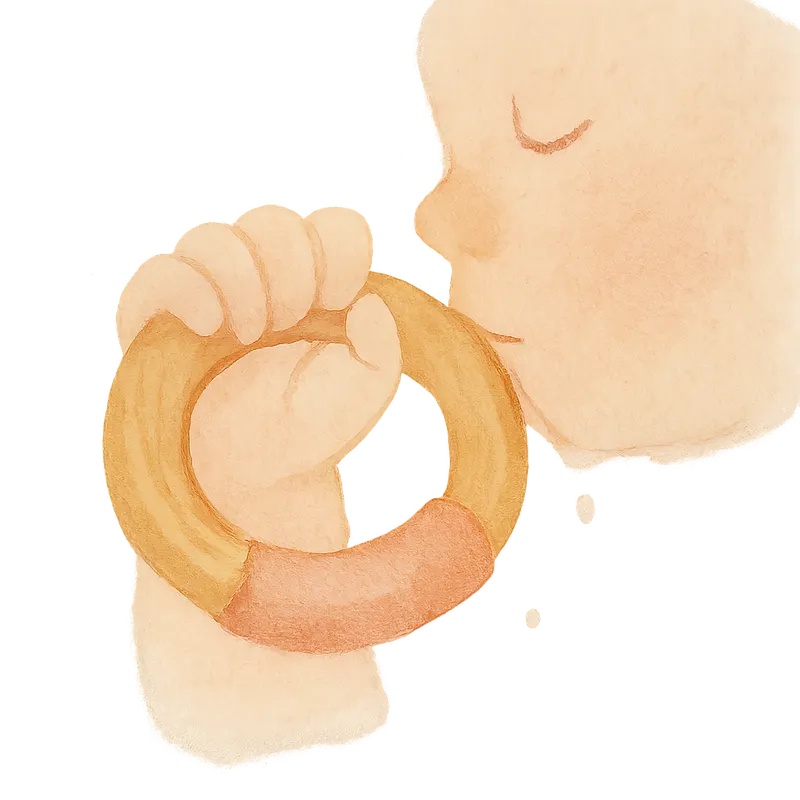
A clean, cool teething ring and a patient cuddle is the most useful “treatment” there is. The evidence base for teething products is thin because the discomfort is usually mild.
Safe and useful
- A clean, cool (not frozen) teething ring: solid silicone or rubber. The pressure soothes; the coolness numbs slightly.
- Chilled (not frozen) face cloth: lightly damp, refrigerated, given to chew
- Gum massage: clean finger, gentle pressure on the gum
- Cold foods for older babies on solids, refrigerated yoghurt, cucumber sticks (always supervised, age-appropriate)
- Extra cuddles, patience, and a slightly easier day
- Paracetamol at a weight-based dose, only if your baby is miserable with it, not as a routine prophylactic
- Drool bibs and a thin layer of plain emollient (like sorbolene) on the chin to prevent drool rash
Things to avoid (some are unsafe)
- Teething necklaces and bracelets (amber, silicone or otherwise): strangulation and choking risk. The ACCC and Red Nose Australia have safety alerts; do not use, even when “supervised”.
- Frozen teething rings or food: too cold, can cause frostbite-like skin damage and even gum necrosis
- Teething gels containing benzocaine (some imported products): TGA-banned for under-2s; risk of methaemoglobinaemia
- Lidocaine teething gels: TGA does not recommend; risk of overdose; also reduces gag reflex
- Homeopathic or “natural” teething tablets: many recalled internationally for inconsistent belladonna content
- Hard biscuits (“rusks”): sugar content + choking risk; not recommended in current guidelines
- Aspirin: never in children under 16
- Alcohol or “rubbing brandy on the gums”: old wives’ tale; toxic to babies
Caring for new teeth
The day the first tooth comes through is the day to start oral hygiene.
Caring for baby teeth
- Start cleaning from the first tooth: a soft baby toothbrush, morning and before bed.
- No bottle in bed: milk and formula pooling around the teeth is a leading cause of early decay.
- See a dentist early: most guidance suggests a first visit by around the first birthday, or within 6 months of the first tooth.
- For the detail, which toothpaste and how much, fluoride, and what dental cover your family may be eligible for, your dentist is the right person to ask. The Australian Dental Association and RCH dental care have parent guides.
When to seek help
Green — usually fine
Normal teething

- Drool, chewing, mild grumpiness for 1–3 days around a tooth
- A bit of drool rash
- Mildly disturbed sleep, slightly less appetite for feeds
- Continues to drink, has wet nappies, and is otherwise themselves
Amber — be alert
Worth a review

- No teeth at 18 months and you’re concerned
- A tooth coming through clearly out of place (very crooked or rotated)
- Unusual swelling beyond the gum line
- A persistent drool rash that’s not improving with emollient
Red — act now
See a doctor: not the dentist: for any of these
- Fever 38°C or above at any age (under 3 months is emergency): see Fever
- Persistent diarrhoea or vomiting
- A baby who is unwell, lethargic, or not feeding
- A non-blanching rash, breathing difficulty, or any other red-flag symptom from When to seek help
Common questions
“My baby is so unsettled: is it teething?”
Maybe, but think about other causes too. The peak teething age (6–24 months) overlaps with the peak of viral illness, the introduction of solids, separation anxiety, and big developmental leaps. Teething alone causes mild discomfort. Persistent or severe distress is usually something else.
“Should I give paracetamol every night while teeth are coming through?”
No. Paracetamol is for discomfort, not prevention. A few days of dosing during a tough eruption is fine; routine nightly paracetamol “just in case” is unnecessary and can mask other illness.
“Are amber teething necklaces safe?”
No. They are a documented strangulation risk and there is no evidence they help. The Australian Competition and Consumer Commission (ACCC) and Red Nose Australia both advise against them.
“My baby’s first tooth is grey: should I worry?”
A tooth that looks grey from the first day is unusual and worth a dentist review (could be a developmental enamel defect or rare local issue). A tooth that becomes grey after a fall or knock can mean nerve damage, also a dentist review. White or yellowish first teeth are normal.
“When should we first see a dentist?”
By the first birthday, or within 6 months of the first tooth appearing. Australian Dental Association recommendation. Most public dentists welcome children for a brief look-and-talk visit early, it normalises the experience.
Related reading
- Common newborn findings
- Fever in babies
- Unsettled baby — the crying peak
- Reflux in babies
- When to seek help
Not sure if it's teething or something else?
If your baby has a fever, isn't feeding, or seems generally unwell, it's not the teeth. See your GP in the first instance, or call the MCH Line on 13 22 29.