
Fever in Babies
Why a fever in a baby under 3 months is always urgent, how to take a temperature accurately, and what helps (and doesn't) at home.
- Last reviewed
- Sources cited
- 6 sources
- Author
- Dr Jubal John, FRACP
- Category
- medical guides
This page is being reviewed
We’re double-checking this content before publishing it — it’ll be available here shortly.
In the meantime, browse the published guides or contact the rooms.
Take-home
A baby under 3 months with a temperature of 38°C or higher always needs same-day medical review
This is one of the firmest rules in paediatric medicine. Any fever in a baby under 3 months, even one, needs an examination, basic blood tests and sometimes a urine sample, because serious infections can present with very few other signs at this age (RCH Febrile child clinical practice guideline). Take baby straight to the emergency department or call 000 if your baby is unwell.
For older babies (3 months and up), the child matters more than the number. A bright, drinking baby with a temperature of 39°C is usually fine to manage at home; a flat, dehydrated baby with 37.8°C may not be.
What counts as a fever?
A fever is a body temperature of 38°C or higher, taken accurately. The body’s set-point rises in response to infection, the fever itself is the body’s normal defence mechanism, not the disease.
The age cut-off matters
- Under 1 month: any fever is treated as a possible serious infection until proven otherwise
- 1–3 months: any fever needs same-day review, ideally with examination and tests
- 3–6 months: lower threshold for review, but most have a viral cause
- Over 6 months: focus on the child, not the number; most fevers are short, self-limiting viral illnesses
These are the RCH and NICE guidelines. The reasoning is that bacterial infections in babies under 3 months, meningitis, sepsis, urinary infections, can progress quickly and present with very few “obvious” signs.
How to take an accurate temperature
The method matters as much as the number.
Green — usually fine
Recommended in babies and young children

- Digital thermometer in the armpit (axillary): under 5 years; inexpensive, safe, accurate enough for most decisions
- Digital thermometer in the rectum: most accurate in babies, but rarely needed at home
- Tympanic (ear) thermometer: accurate from about 6 months; not reliable in young babies because of the narrow ear canal
Amber — be alert
Less reliable

- Forehead strips and non-contact infrared scanners: convenient but vary widely; if reading is high or borderline, always confirm with an axillary digital thermometer
- Feeling the forehead with your hand: misses about half of true fevers and detects “fever” when there is none. Useful as a screening cue, not a diagnostic tool.
Red — act now
Not recommended
- Mercury thermometers: risk of toxicity if broken; replaced by digital decades ago
- Mouth (oral) thermometers in babies and young children, accuracy depends on cooperation
How to do an axillary reading
- Make sure the underarm is dry
- Place the tip in the centre of the armpit, against the skin
- Hold the arm firmly down across the chest so the thermometer is fully covered
- Wait for the beep (most digital thermometers, 30–60 seconds)
- Add 0.3–0.5°C mentally if you want to estimate the core temperature, but the reading itself is what we treat in young babies
When to seek help: by age
Always seek immediate care, at any age, for:
- A baby who is floppy, unresponsive, or hard to wake
- Difficulty breathing, grunting, blue lips, or chest drawing in
- A non-blanching rash (does not fade when you press a glass against it)
- A seizure or unusual jerking
- Severe headache, neck stiffness, or photophobia in older infants
- A baby who will not feed at all or who has not had a wet nappy in 8+ hours
- Persistent vomiting, or any green (bilious) vomit
- A fever lasting more than 5 days at any age
- Your gut feeling that something is seriously wrong: parents are often right
What to do at home (3 months and older)
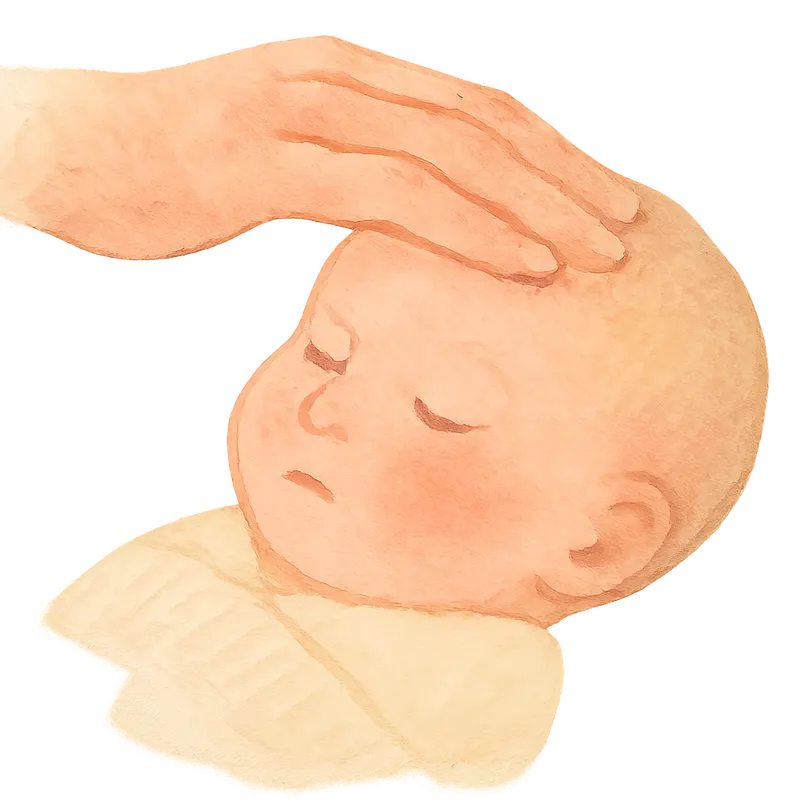
The goal is comfort and hydration, not chasing the number down. The fever itself is the body doing its job.
Safe and useful
- Plenty of fluids: breast or bottle on demand, water if older than 6 months and on solids. Small, frequent sips are easier to keep down than a big drink.
- Light clothing: one layer plus a light wrap. Babies cool through the head; over-wrapping makes the fever rise.
- Comfortable room temperature: 18–22°C
- Rest: sleep is when the immune system does most of its work
- Paracetamol: at the correct weight-based dose, only if your baby is uncomfortable. Read the label, double-check with your pharmacist or MCH nurse if unsure.
- Ibuprofen: not under 3 months, generally avoided under 6 months without medical advice. From 6 months it can alternate with paracetamol if needed.
- Wet nappy count: fewer than 4 in 24 hours is a flag for dehydration
Old advice that doesn't help, and can harm
- Tepid sponging or cold baths: no benefit, makes baby uncomfortable, and can cause shivering (which raises temperature)
- Cool / cold water immersion: avoid; can cause hypothermia
- Aspirin: never in children under 16 (Reye’s syndrome risk)
- Combined cough/cold/fever syrups: avoid; not recommended under 6 years
- Alternating paracetamol and ibuprofen “by the clock”: current guidelines (RCH, NICE) say only alternate if baby is uncomfortable, not as a fixed schedule
- Stripping baby naked: small drop in temperature, but the cooling tends to make baby shiver and feel worse
Paracetamol dosing: read the bottle
We don’t publish specific doses on this site. The right amount depends on your baby’s weight and the concentration of the suspension you have, both of which you can check on the bottle.
- Read the label for the dose corresponding to your baby’s weight band
- If anything is unclear, ask your pharmacist or call the MCH Line on 13 22 29 before giving the first dose
- Don’t double-dose if it doesn’t seem to be working, phone for advice instead
- For the authoritative figure-by-figure plain-English version, see HealthDirect — paracetamol for children and RCH Kids Health Info — pain and fever medicines.
Why fevers happen: quick reference
The cause is what matters; the temperature is just a sign.
Watch closely — MCH Line 13 22 29 for advice
Common (most fevers in babies)
- Viral upper respiratory infections: colds, runny nose, mild cough
- Roseola: high fever for 3 days, then rash as fever breaks
- Hand, foot and mouth disease: fever + spots in mouth and on hands/feet
- Influenza: abrupt onset, more unwell
- Bronchiolitis: fever + cough + harder breathing (see Bronchiolitis)
- Gastroenteritis: fever + vomiting/diarrhoea
- Post-immunisation fever: common 6–24 hours after vaccinations (see Immunisations)
Uncommon but important
- Urinary tract infection (UTI): around 5–7% of febrile infants under 3 months have a UTI (higher in uncircumcised males), which is why a urine sample is part of the workup
- Pneumonia: fever + fast breathing, work of breathing
- Bacterial meningitis: rare but serious; fever, irritability, poor feeding, bulging fontanelle
- Sepsis (bloodstream infection): rare; baby looks generally unwell, lethargic, mottled, cold extremities
Common questions
“How high is too high?”
Above 6 months, the height of the fever matters less than how the child looks. Some viruses produce 39–40°C with a child still drinking and chatting; some serious bacterial illness produces only 38°C in a flat, mottled baby. Trust the appearance, not the number.
“My baby is shivering: should I cover them more?”
Shivering (rigors) can happen at the start of a fever as the body’s set-point rises. Don’t pile on blankets: let the body do its thing. The shivering passes within 20–30 minutes and the temperature will be at its new set-point.
“The fever broke and now there’s a rash: should I worry?”
A rash that appears as the fever resolves is classic for roseola, a benign viral illness. The rash is small, pink, blanching (fades when pressed) and the baby is well. A non-blanching rash (doesn’t fade with a glass test) at any time, fever or not, is an emergency, call 000.
“Can teething cause a fever?”
Not really. Australian and international guidelines are clear: teething does not cause fevers above 38°C. A baby with teething behaviour and a fever has a fever from another cause that needs the same review as any other fever, it is not the teeth. See Teething.
“Should I wait it out before going to ED?”
For an under-3-months-old, no, go now. For 6 months and older, watching for an hour and seeing how feeding and behaviour respond is reasonable. If you’re worried, ring: MCH Line 13 22 29 can help you decide.
Related reading
A fever in a baby under 3 months is always a 'go now' moment
If your baby is under 3 months and has a fever, go to the nearest emergency department. For older babies, see your GP in the first instance, or call the MCH Line on 13 22 29.